Students who are taking the entrance exam
to the College Counseling Center.

Veterinary Medicine Overview

Celebrating the Beauty of Diversity Between Humans, Animals & Nature

現代社会において人々の生活は多様化し、人間性回復のために自然や動物との関係を深め、健康に配慮しながら個性を重視する時代となることが予想されています。一方、人口増加や経済活動の発展にともなう環境破壊により、新しい感染症の発生や、食糧危機が懸念されています。地球規模の問題解決のため、そして、世界中の人々が等しく豊かな生活を送るために、「動物生命科学」が大きな役割を果たそうとしています。このため、北里大学獣医学部では、微生物から動植物・地球環境までを対象とした幅広い研究活動を行っています。

微生物から動植物、環境まで―。
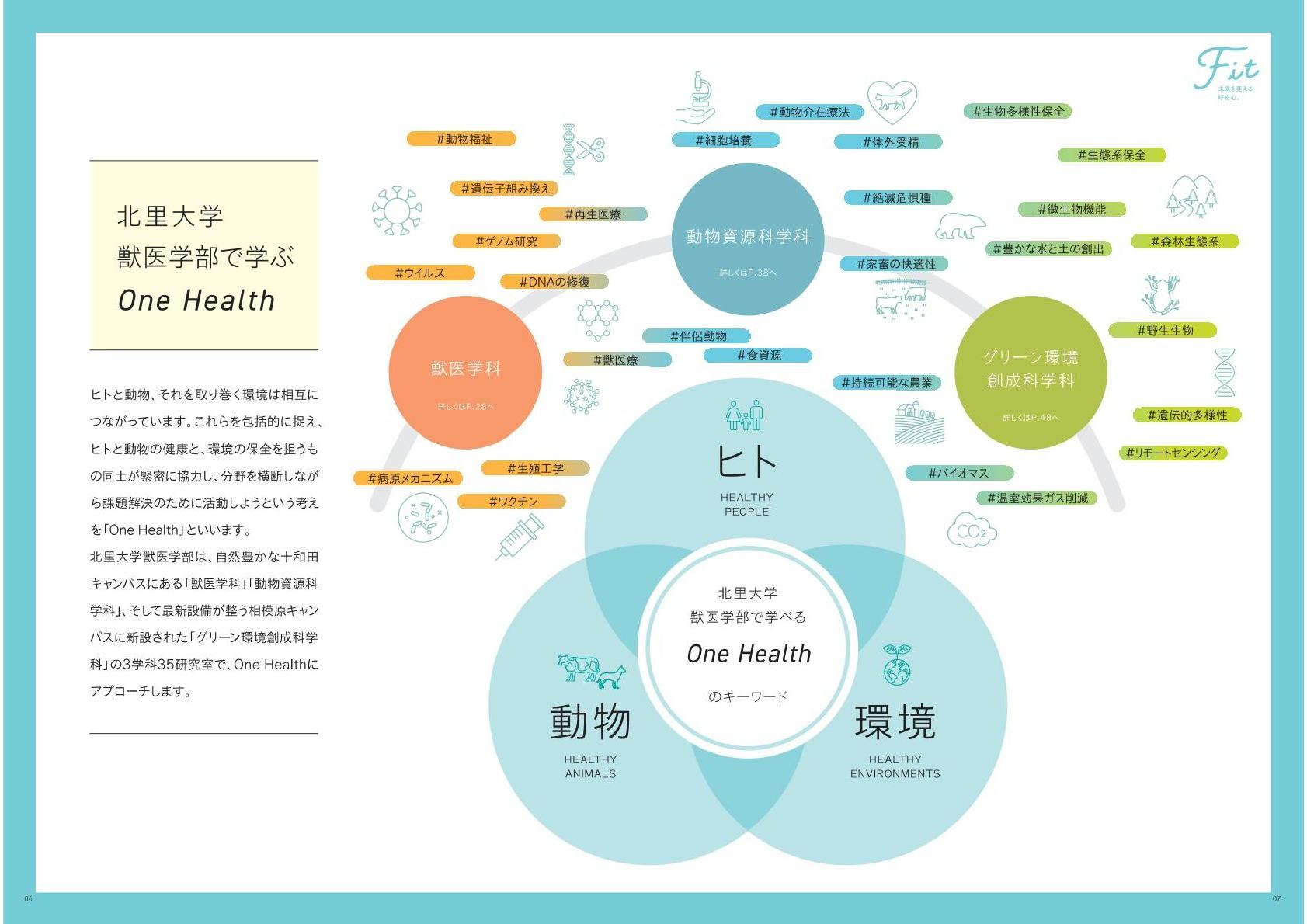
獣医学部には、人と動物の共存を地球規模で考える「グリーン環境創成科学科」「動物資源科学科」「獣医学科」の3学科があります。

自然と共生する社会の実現に貢献し、環境保全のスペシャリストを育成する「グリーン環境創成科学科」
生命の誕生から動物の行動、人と動物の関係、食と健康の関係を学ぶ「動物資源科学科」
伴侶動物・産業動物・野生動物の病気と闘う獣医師を育成する「獣医学科」

[動物生命科学]
を主軸に、3学科が有機的に連携した高度な教育・研究を進めます。

Education & Research Objectives

  1. Discovering new biological functions in animals
  2. Enhancement and development of veterinary medicine through the diagnosis, treatment, and prevention of animal diseases
  3. Advancement of public health
  4. Animal husbandry and food production
  5. Production infrastructure to secure food resources
  6. Promotion of food safety, environmental conservation, and sustainable agriculture needed to solve global issues

Agromedicine Projects

The Kitasato University School of Veterinary Medicine produces agromedicine specialists who combine medical and agricultural knowledge with the problem-solving skills needed for future society.
The university-wide Agromedicine Education Program encourages students to develop multifaceted perspectives that transcend the boundaries of traditional academic disciplines, producing specialists who can address areas in high demand.

Our world is growing ever more complex in the 21st century. It is essential that education and research integrate the fields of medicine and agriculture to help prevent disease, promote health, ensure safe and healthy food, and advance sustainable agriculture and care farming. Kitasato University is a comprehensive university dedicated to the life sciences. It comprises seven undergraduate faculties and seven graduate schools, including two agricultural schools (School of Veterinary Medicine, School of Marine Biosciences) and four medical schools (School of Medicine, School of Pharmacy, School of Nursing, School of Allied Health Sciences). At Kitasato, the unique specializations of each faculty are vertically integrated, while horizontal connections link medical and agricultural fields related to food, the environment, and health. This integrated curriculum makes the university perfectly equipped to promote agromedicine research. Education and research for agromedicine is a core theme throughout Kitasato University and takes a number of forms: empirical research on sustainable livestock and environmental conservation; promotion of medicinal plant cultivation using remotely operated botanical garden models; as well as joint symposiums with other universities and community outreach programs.

Professional Development in Four Areas in High Demand

Medical Animal Science

Pharmaceutical and laboratory animal production companies, etc.
✓ In Vitro Fertilization
✓ Cloning
✓ Laboratory Animal Technicians

Animal-Assisted Therapy & Activities

This field is still relatively new in Japan, with increased demand expected in the coming years.
✓ Zoonosis
✓ Public Health
✓ Clinical Pathology
✓ Animal-Assisted Therapy & Activities

Food Safety

This field requires a wide range of knowledge, including a fundamental understanding of medical science.
✓ Pathogenic Bacteria
✓ Microbiology
✓ Food Safety assessments
✓ Safety Evaluation Systems

Assisted Reproductive Technology

This field requires professionals trained in agromedicine, with both medical expertise and ample experience with animals.
✓ Embryologists for ART in Humans

人と動物、自然の共存を学ぶ4つの学科

veterinary medicine

The Veterinary Medicine curriculum is unique to Kitasato University and aims to enrich and strengthen clinical education on animals and livestock as well as public health, covering subjects in basic, applied, and demonstrative fields efficiently and in a professional manner.

  • Advanced Treatments for Companion Animals
  • Prevention & Treatment of Disease
  • Animal Health & Food Safety
Learn More

Department of Animal Resource Science

With an emphasis on the basic fields of zoology, the Animal Science curriculum is rich in content, constantly incorporating new areas of study such as human-animal relationships and cellular- and molecular-level approaches, allowing students to study at the cutting edge of animal science.

  • Animal Cloning
  • Promotion of Animal Welfare
  • Animal Therapy Development
Learn More

Department of Green Environment Creation Science

マクロからミクロまで。

豊かな生態系を未来へ引き継ぐため、環境を「診る」「治す」「活かす」ための知識と技術を体系的に学びます。

  • 環境を診る:デジタルサイエンス・リモートセンシングを活用し、生態系を「見える化」する
  • 環境を治す:生態系における物質の流れを明らかにし、未利用資源を活かして環境問題の解決に挑む
  • 環境を活かす:微生物の力を理解し、環境・生命を支える技術へつなげる
Learn More

Department of Biological and Environmental Sciences

The Environmental Bioscience curriculum is centered on environmental management, conservation, and restoration. Students learn to elucidate the functions of the region-specific biological environments and maintain biodiversity, managing and conserving sustainable biological environments in harmony with nature and creating rich environments for the survival of organisms.

  • Wildlife Conservation
  • Environmental Symbiosis Design
  • Eco-Management Research
Learn More

A Farm & Woodland Campus

Towada Campus has a total area of 38.4 hectares and includes the 21-hectare Towada Farm. The campus is home to stables, barns, pastures, and other facilities that allow our faculty to leverage their specialized knowledge and conduct a wide range of educational activities. Student apartments are just a short walk away, giving students an easy commute and allowing them to focus on their studies.

Learn about Getting to Campus

History of the School of Veterinary Medicine

1966
The Faculty of Animal Husbandry established with the departments of Veterinary Medicine and Animal Science
1970
Master’s program added at the Graduate School of Animal Husbandry
1972
Doctoral program added at the Graduate School of Animal Husbandry
1978
- Faculty of Animal Husbandry renamed to Faculty of Veterinary Medicine and Animal Husbandry - Graduate School of Animal Husbandry renamed to Graduate School of Veterinary Medicine and Animal Husbandry
1981
Department of Animal Husbandry & Civil Engineering added Six-year integrated veterinary medicine education program begins
1987
Master's program in Animal Husbandry & Civil Engineering added at the Graduate School of Veterinary Medicine and Animal Husbandry
1990
Four-year doctoral program in Veterinary Medicine established at the Graduate School of Veterinary Medicine and Animal Husbandry
1999
- Department of Animal Husbandry renamed to the Department of Animal Science - Department of Animal Husbandry & Civil Engineering renamed to the Department of Biological Production and Environmental Science
2003
- Concentration in Animal Husbandry at the Graduate School of Veterinary Medicine and Animal Husbandry renamed to the Concentration in Animal Science - Concentration in Animal Husbandry & Civil Engineering at the Graduate School of Veterinary Medicine and Animal Husbandry renamed
2007
Faculty of Veterinary Medicine and Animal Husbandry (Faculty of Veterinary Medicine, Department of Animal Science, Department of Biological Production and Environmental Science) restructured as the School of Veterinary Medicine (Faculty of Veterinary Medicine, Department of Animal Science, Department of Environmental Bioscience)
2011
The Graduate School of Veterinary Medicine and Animal Husbandry (Concentration in Veterinary Medicine, Concentration in Animal Resource Science, Concentration in Biological Production and Environment) restructured as the Graduate School of Veterinary Medicine (Concentration in Veterinary Medicine, Concentration in Animal Science, Concentration in Environmental Bioscience)
令和7(2025)年
グリーン環境創成科学科発足
Learn More About the History of Kitasato University